Shivangi Bajpai: Being a Visual Designer
Shivangi designs with empathy, curiosity, and a lot of heart.
In this interview, she reflects on her path from India to London, the joy of creating, and how inclusive thinking shapes everything she makes.
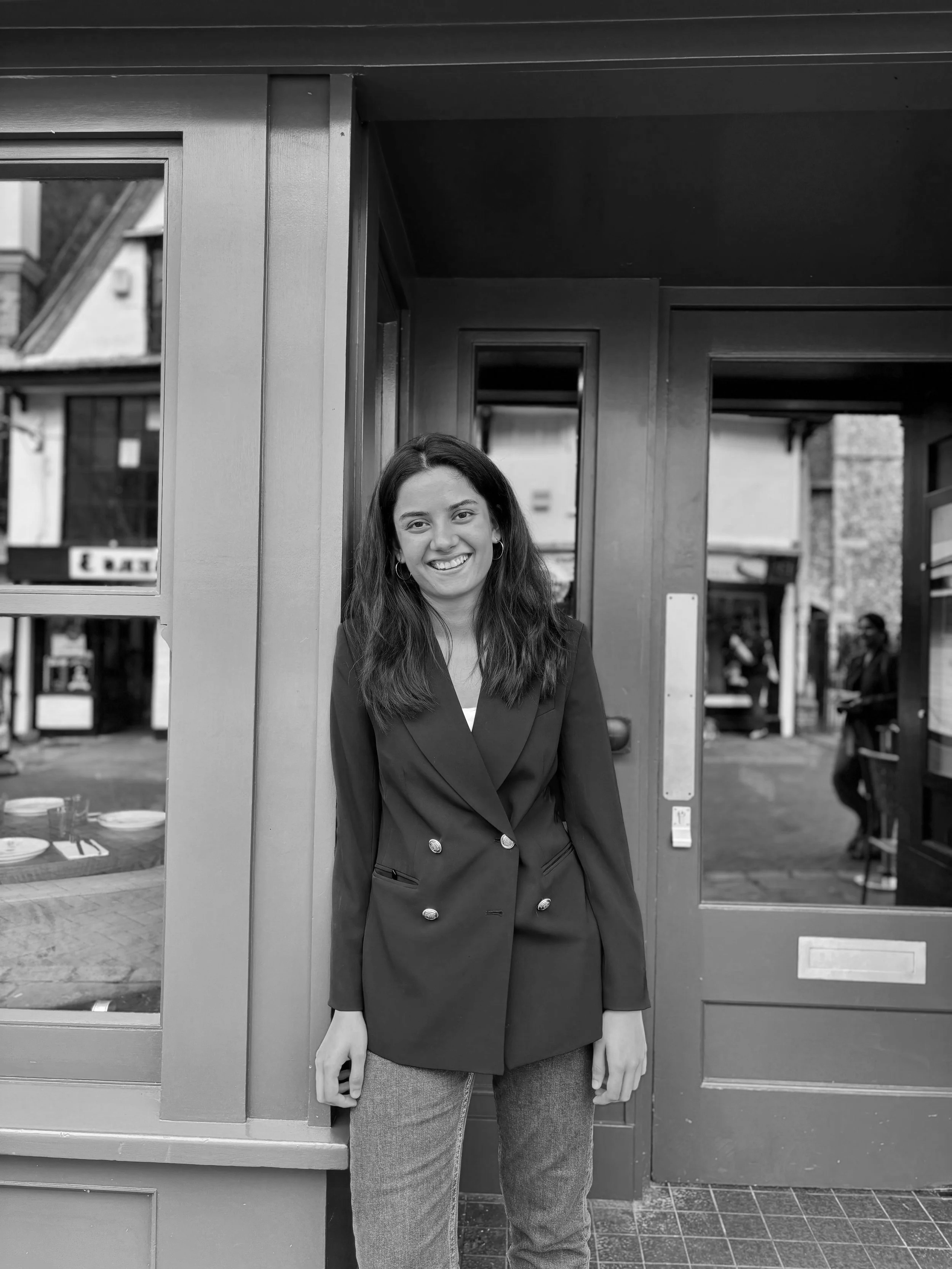
What’s the most straightforward way to explain who you are and what you do?
I’m a visual designer, mainly working across brand identity, typography, and illustration. I’m originally from Varanasi, India, and I’m currently building my practice in London. A lot of how I think and design comes from where I grew up. Varanasi is one of the world’s oldest cities, and growing up in a joint family, alongside studying business for my bachelor’s degree, meant I was constantly surrounded by a mix of tradition, empathy, and practicality.
My work naturally sits between these energies and my own playful personality. It can be bold, experimental, and slightly funky, but it can also be empathetic, thoughtful, and rational when the context calls for it.
I recently completed my MA in Graphic Branding and Identity at London College of Communication. My final major project, Together in Transit, was developed as a hypothetical branding intervention for Transport for London (TfL), exploring how small communication changes could make public transport more inclusive for neurodivergent people. The project involved close observation of everyday travel behaviours, translating these insights into a campaign aligned with TfL’s existing tone and visual language.
Since graduating, I’ve been actively looking for full-time roles that allow me to grow professionally and strengthen my design practice. Alongside this, I’ve been attending events, talks, and meet-ups around London to stay connected and better understand how the creative industry here actually works.
What assumptions do people make about you? How right are they?
People often assume that because I’m quiet, I’m either underconfident or don’t have strong opinions. That’s not really true. I’m more observant than outspoken, and that’s central to how I work as a designer. I tend to form opinions by watching, listening, and understanding people and situations first, and then articulating my point of view when it feels relevant.
Another assumption is that being a designer means you’re constantly creative. I share my work fairly regularly on LinkedIn, which probably adds to that impression. In reality, design involves constant exposure to other people’s work, which can be inspiring but also intimidating. There are days when things flow, and days when seeing so much good work brings a lot of self-doubt. Imposter syndrome is very real in this field. I try to find balance, show up consistently, and give myself space for both kinds of days.
What’s your background to get you to where you are today?
Maybe the best way to explain it is with the saying, sometimes the wrong train takes you to the right station.
Like most people around me, I followed what felt like the sensible route. I moved away from home to study Commerce for my bachelor’s degree, but I struggled, felt homesick, and eventually moved back to Varanasi to finish my degree. At the time, it felt like I’d failed a bit, but that break ended up being important.
During that period, a friend introduced me to Adobe Photoshop. It felt intuitive, and I kept returning to it out of curiosity. Most of what I learned at that stage came from teaching myself and experimenting on my own. Over time, that interest grew into a clearer direction, which led me to pursue a Diploma in Advertising and Graphics after my bachelor’s degree and take on freelance design work, small projects, internships, and anything I could learn from.
Gradually, I realised I was drawn to more detail-oriented work. Image manipulation became something I spent a lot of time on, particularly around lighting, shadows, and refining visuals, and I slowly leaned more towards advertising. That interest resulted in a full-time role at Schbang, one of India’s leading advertising agencies.
Working there taught me a great deal, but it also made me realise I didn’t want to stop learning.
LCC felt like the right next step to strengthen my practice and be exposed to more refined work. It helped me sharpen my technical skills and work across a wider range of disciplines. Now, I’m keen to continue developing my practice in London and explore how my skills can be used to create meaningful impact.
What excites you most about what you do?
On a basic level, it’s exciting to see an idea turn into something tangible. But what excites me more is how present design is in everyday life. There’s so much scope to influence behaviour, perception, and everyday experiences. Together in Transit, my MA project, is one manifestation of that belief.
Design has also trained me to see the world through so many eyes. You begin noticing things without trying. And when you put something out into the world, someone else relates to it in their own way, that feels like a powerful form of human connection. I feel at home when I’m designing. The more I practise, the more things start to make sense.
Any tips for aspiring designers?
A lot of creative work feels automated right now, and because of that, emotion and intention matter more than ever. Bringing a bit of yourself into what you make helps the work feel human. Originality and authenticity are important here.
Also, share your work, even the small things. Putting my work out there helped me meet people who were generous with feedback and advice, which made a big difference early on. Sharing also opens you up to new perspectives and keeps the work from feeling too individualistic.
Early on, I think it really helps to take on as much work as you can. It gives you space to experiment, learn, and slowly understand what feels natural to you. Try to enjoy what you’re doing, especially the process part of it.
A niché question but an important one...How aware are you about accessibility?
“Nothing about us without us” is something I’ve come to believe in over time. At the very least, design should be for everyone. My understanding of accessibility grew significantly while working on my MA project, Together in Transit.
That awareness showed up in practical design decisions. I paid close attention to typography, choosing typefaces that felt familiar but were easier to read and less visually demanding. Colour choices were made not only for brand consistency, but also for legibility and sensory impact. QR codes were used to extend information beyond posters, allowing people to engage at their own pace. More broadly, the entire project was rooted in inclusion and accessibility.
Along the way, I connected with designers exploring similar questions and visited exhibitions focused on lived experience and disability, including work at the V&A, the Wellcome Collection, and Alison Lam’s Mind the Gap at the Museum of the Home. These experiences helped me see how accessibility can be approached thoughtfully in practice.
Today, accessibility feels non-negotiable when I begin ideating anything I create.
And finally, What's the plan for you? Where you heading?
Right now, what feels right is continuing to learn through full-time experience and understanding how things work in practice. I’m experimenting more with motion, typography, and illustration to broaden my skill set, and this phase of exploration feels important in shaping the kind of designer I want to become.
What matters most to me is that people can feel the care, thought, and intention behind the work I put out. Amplifying the work is something I’m actively working on, too. There will be challenges, of course, but I try to approach them with the same mindset that has guided me so far: staying curious, creating with love, and being empathetic.
I’m often reminded of something I once read: “You, as an artist, have the greatest responsibility of all, you are charged with trying to make people feel, in a world that tells them not to.” (Thomas, 2010, p. 151)
I hope the future continues in that direction, with work that feels meaningful.
Links: Keep up to date with Shivangi
Website - shivangibajpai.cargo.site
Linkedin - linkedin.com/in/shivangibajpai1